


GGPoker Statistics Guide: How to Read Opponents Better
A good GGPoker statistics guide starts with one simple truth. Numbers do not replace judgment. They sharpen your reads. They speed up decisions. They reduce avoidable guesswork. On GGPoker.be, that matters because the platform gives players built-in tools to track tendencies, review sessions, and study how opponents approach key spots. For players in Belgium, the appeal is not just the game selection. It is also the chance to use clear data to make better decisions at the table.
Why stats matter on GGPoker
GGPoker’s main stats tools are Smart HUD during play and PokerCraft after the session. Smart HUD helps you identify player types in real time. PokerCraft helps you review hands later. That combination is useful. It creates a bridge between table reads and session study. It also keeps the process simple. You do not need a messy setup.
That matters even more on a platform where third-party tracking tools are restricted. GGPoker builds its own data ecosystem inside the client. That makes the learning curve lighter. It also helps level access. Players are competing with interpretation, not just software.
The first stats to check
The basic Smart HUD line usually starts with VPIP, PFR, ATS, 3BET, and the number of hands. These numbers form the first impression. They help very quickly.
VPIP shows how often a player voluntarily puts money into the pot before the flop.
PFR shows how often they raise before the flop.
ATS measures how often they try to steal blinds from late position.
3BET shows how often they re-raise after an open. The hand sample tells you how much trust to place in those percentages.
The real value comes from reading them together. That is the key point.
A high VPIP with a low PFR usually points to a loose player who calls too much and takes the initiative too rarely.
A smaller gap between VPIP and PFR often points to a more disciplined profile.
ATS helps you judge late-position pressure.
3BET helps you judge re-raise pressure.
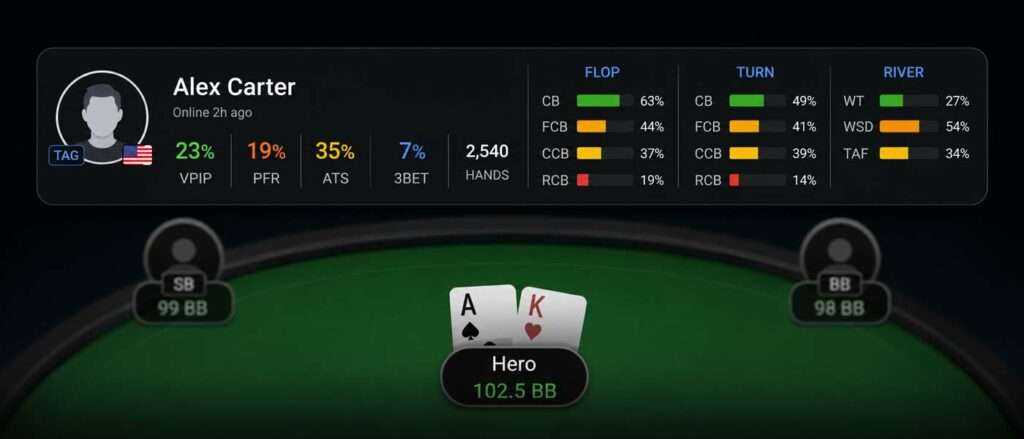
Reading the example image
The image above shows a clean regular TAG profile rather than a loose recreational one. That makes it useful. The sample is already meaningful, with 2,540 hands, so the broad trends deserve attention.
At the top, the main numbers are 23% VPIP, 19% PFR, 35% ATS, and 7% 3BET. This is a solid structure. It looks very controlled and highly coherent. This player is not entering too many pots, is raising most of the hands they choose to play, steals at a healthy but not excessive rate, and uses re-raises often enough to stay dangerous without looking reckless.
The most important detail is the small VPIP to PFR gap. A 23/19 profile is usually disciplined pre-flop. It suggests fewer loose calls and a stronger preference for taking the initiative. That gap matters greatly. It tells you this player is usually entering pots with a plan.
The 35% ATS also fits the same identity. This player is not attacking every blind on autopilot, but is clearly aware of late-position opportunities. The 7% 3BET strengthens that read. It is active enough to show pressure, yet controlled enough to look like a standard regular rather than a spewy player. That balance is important. It is a regular’s balance.
What the flop stats suggest
The post-flop numbers support the same reading. On the flop, the panel shows CB 63%, FCB 44%, CCB 37%, and RCB 19%. That suggests a player who continuation-bets often enough to apply pressure, but not so often that every missed board becomes an automatic stab.
The reaction stats also look balanced. This profile does not fold too easily. It does not call everything. It still has enough raising frequency to fight back. That makes it harder to bully. It also makes it harder to over-bluff.
Against this type, lazy assumptions cost money. You cannot just label the player “tight” and stop there. You need more detail. You need more context.
What the turn stats suggest
The turn line remains fairly stable, with CB 49%, FCB 41%, CCB 39%, and RCB 14%. That drop from flop to turn is healthy. It usually means the player becomes more selective as the pot grows. That is what you expect from a composed TAG rather than from a pure volume aggressor.
This is a useful clue. It changes strategy directly. A player who barrels the flop often but the turn more selectively is usually choosing stronger turn ranges. That means careless floats lose value. It also means poor double barrels get punished less often than bad flop stabs, because this type already filters their range more cleanly by the turn.
What the river stats suggest
On the river, the profile shows WT 27%, WSD 54%, and TAF 34%. A WT figure in that area suggests the player is not dragging too many weak hands to showdown. A 54% WSD is solid and usually points to better hand selection in bigger pots. TAF at 34% fits the same overall picture. This player can apply pressure. But it is structured pressure.
That matters late in hands. It matters a lot. If this player reaches showdown, the range is usually cleaner than that of a loose caller. If this player keeps betting, the line often deserves respect. Not automatic blind fear. Just apply measured respect.
What these numbers say overall
Taken together, these numbers describe the kind of opponent who is harder to exploit. They are active, but not loose. They are aggressive, but not reckless. They raise more than they call. They steal when position allows it. They reach showdown with stronger ranges than a recreational player usually would.
In plain terms, this is a regular TAG. The numbers support that label. The street data supports it too. Nothing looks truly random. Nothing looks structurally messy.
How the stats help at the table
The value of a stat panel like this is not just description. It changes table decisions. That is the practical edge.
If you see a high VPIP and low PFR, value betting becomes more attractive. If you see a low ATS, blind defence should be tighter. If you see a high 3BET, lighter opens may get punished. If you see a balanced TAG profile like the one in the image, you know you are dealing with ranges that tend to be coherent across streets.
The street-by-street blocks also help with line planning. A player who folds too often to flop continuation bets can be pressured earlier. A player who continues more often on the turn should make you more selective with double barrels. River numbers then help you judge whether they arrive too wide or too strong at showdown. Small numbers matter here. Timing matters there too.
Why PokerCraft still matters
Smart HUD is the live read tool. PokerCraft is the study room. It lets you review sessions, check your own VPIP, PFR, 3BET, ATS, and positional win rates, and look for trends over time. That matters because many poker players try to fix everything at once. That approach rarely works. Good review work starts with one leak. Then make one correction. Then build a new sample.
PokerCraft also keeps the review process inside the same ecosystem. You can look up best and worst hands, search by opponent, add notes, and revisit key pots without leaving the GGPoker environment. That clearly lowers friction. It makes study easier. Easier study gets used.
Why the app feels different
GGPoker’s app stands out because the client does more than offer tables and tournaments. It also gives players room to shape the playing environment.
Profile customisation is one obvious difference. Players can update avatars and personalise identity elements. Table appearance can also be adjusted through theme settings, including felt and card design choices. Custom Table Layouts go further by letting players save preferred arrangements for different numbers of tables, which is especially useful for regular multi-tablers.
There is also a practical side. Players who want fewer distractions can use Helmet Mode, which blocks several social and visual interruption features. That matters on mobile. It matters on desktop too. Some players enjoy the more social presentation. Others want a cleaner, quieter screen. GGPoker gives both groups more control than many traditional clients.
Play-money is useful, but different
One caution belongs in any honest GGPoker statistics guide. Play-money tables are useful for learning controls, testing layouts, and getting comfortable with the interface. They are not a fully reliable mirror of real-money poker.
GGPoker clearly separates play-money tables from real-money tables, and play-money games are identified by chip values rather than currency symbols. That clear difference matters. The player pools are different. The incentives are different. The behaviour is different. Players often take much wilder lines with fictitious chips. Table and tournament availability can also differ from the real-money environment.
So yes, play-money mode is helpful for learning the software and trying the app. It is useful early. It is not useless. But if the goal is to understand actual opponent tendencies, real-money games are the more useful benchmark. Reads built in one environment do not always transfer neatly to the other.
Final thought
A strong GGPoker statistics guide is not really about memorising abbreviations. It is about learning how numbers fit together. Smart HUD helps you identify player types in real time. PokerCraft helps you review whether your own game is moving in the right direction. The app then adds another layer through profile, table, and focus customisation that many poker clients still handle less well.
That is why GGPoker’s statistical tools matter. They do not remove uncertainty from poker. They reduce avoidable guesswork. When you read the numbers properly, you stop reacting to one hand and start reacting to patterns. That is the real gain. That is the long-term edge.

No responses yet