


GGPoker vs PokerStars Belgium: why GG has the edge
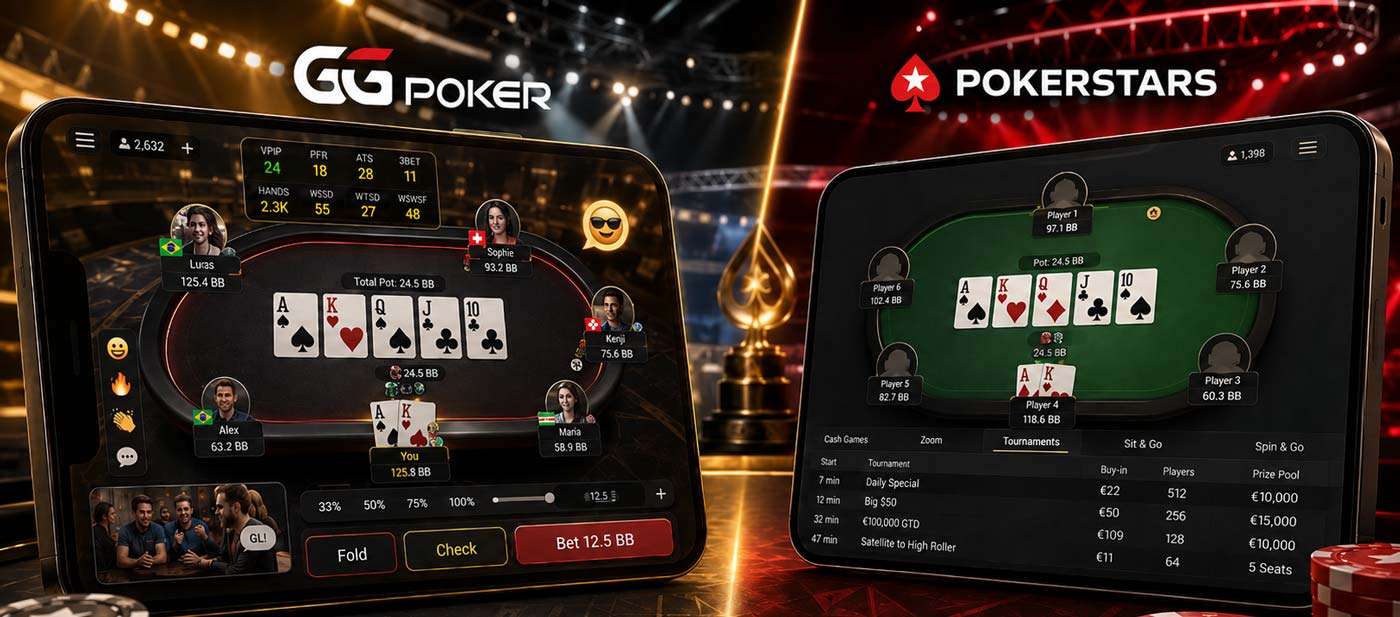
In 2026, the GGPoker vs PokerStars Belgium comparison is no longer based only on reputation. Both poker rooms are legal. However, their applications now provide two very different experiences.
PokerStars retains its historic identity. GGPoker offers a more modern application. Its advantage becomes particularly clear in profile customisation, table interaction and directly accessible poker statistics.
Two legal platforms with different approaches
GGPoker.be operates legally in Belgium with Belgian B and B+ 3805 licences. PokerStars.be also operates within the regulated Belgian market, under A+ 20635 linked to the Casino de Namur. Both platforms restrict real-money poker to players aged 21 or over.
Security is therefore not the only distinguishing factor. The main difference lies in the user experience. Our full GGPoker Belgium review already highlights its application-focused approach. Our PokerStars Belgium analysis presents a more traditional, extensive and established poker room.
A more modern application at GGPoker
GGPoker provides a modern lobby. Its main formats remain easy to access. Important information is presented clearly.
PokerStars also offers a stable and functional application. However, its interface feels more traditional. Its lobby can sometimes appear crowded.
This difference directly affects everyday comfort. GGPoker prioritises a modern user experience. PokerStars maintains a more established and conventional approach.
Profiles and tables: GGPoker offers more identity
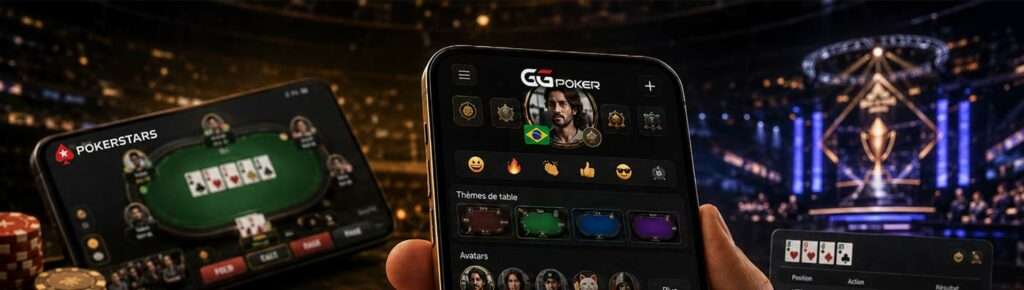
Customisation creates a clear difference. GGPoker provides a customisable avatar. Its settings include table styles, felt colours and several display preferences.
This personalisation goes beyond visual changes. The player profile also provides access to notes, statistics and social settings. Players can, for example, block another player’s SnapCam videos directly from their profile page.
PokerStars remains strong in traditional visual themes. Several interface elements can be adjusted. Its desktop software provides a wide selection of appearance settings.
The main difference concerns overall integration. PokerStars effectively customises the visual environment. GGPoker more closely connects the player profile, poker table, reactions and game information.
Emotes, GIFs and table interactions
GGPoker turns each poker table into an interactive space. Emojis and reactions remain available. Players can also send voice messages. SnapCam allows them to share a short video at the table.
“Splashes” add another playful element. Certain pots unlock a virtual object. That object can then be thrown towards the winner.
The chat also supports GIFs. These functions make the table feel more social. They can still be disabled when a player prefers a quieter environment.
PokerStars provides its own “Throwables”. These virtual objects can be directed at an opponent. PokerStars also retains its chat and table animations.
Throwables work effectively, but they remain more secondary. At GGPoker, interaction is central to the experience. These features contribute directly to the platform’s visual identity.
GGPoker’s main advantage: integrated statistics
The GGPoker vs PokerStars Belgium comparison becomes clearly favourable to GG when data analysis is considered. GGPoker integrates its statistics directly into the application. No external software is required.
The Smart HUD displays five essential preflop statistics. They appear beside the avatar during the session. Together, these figures help describe each opponent.
VPIP: frequency of participation
VPIP measures how often a player voluntarily enters a pot. A low percentage usually indicates a tight hand selection. A high figure suggests much wider participation.
PFR: preflop raises
PFR measures how often a player raises before the flop. The difference between VPIP and PFR can be particularly informative. A small gap usually indicates a more aggressive playing style.
3-bet: preflop re-raises
The 3-bet statistic measures preflop re-raises. A low value often represents a very strong and selective range. A higher percentage can indicate a more aggressive strategy.
ATS: attempts to steal
ATS measures attempts to steal the blinds. This figure is particularly useful for evaluating how frequently a player raises from late position to attack the blinds.
Hands: sample size
The number of hands provides context for every statistic. Ten observations are not enough to establish a reliable profile. A trend becomes progressively more useful as the sample size increases.
Selecting an avatar opens additional statistics. CB measures continuation-bet frequency. FCB, CCB and RCB respectively show folds, calls and raises against these bets. WTSD indicates how often a player reaches showdown, while WMSD measures the percentage of showdowns won. TAF summarises overall aggression.
These statistics remain limited to the current session. They are reset after the table is closed. A permanent history of opponents is therefore not displayed.
PokerCraft extends the analysis after a session
PokerCraft stores the player’s own data. The tool centralises personal performance statistics. It also separates cash-game and tournament results.
The hand replayer allows players to review important decisions. Filters can isolate large pots, strongest hands and biggest losses. A starting-hand matrix also presents results according to the cards received.
PokerCraft provides an EV estimate as well. Its luck indicator requires at least 1,000 hands. The EV calculation only covers hands that reached showdown. PokerCraft also displays results without deducting rake. The real account balance may therefore differ.
PokerStars provides detailed hand histories and reports. Its hand replayer remains useful for reviewing individual decisions. More advanced analysis generally depends on authorised third-party software. PokerStars does not offer an equally complete native equivalent.
GGPoker prohibits third-party HUDs, but compensates with its own built-in tools. This makes immediate analysis considerably easier. The statistics remain less detailed than some specialist programs, but they are much more accessible for regular players.
Play-money chips do not reproduce real-money poker
Play-money mode demonstrates the interface. It allows players to test the buttons and basic functions. However, its game catalogue differs from the real-money version.
Available tournaments may have different names. Guarantees and schedules can also vary. Certain series remain exclusive to real-money play.
This difference exists on both GGPoker and PokerStars. PokerStars also explains that play-money hands and certain freerolls are not archived in the same way as standard real-money hands. Play-money mode therefore remains mainly demonstrative.
Player behaviour also changes significantly. Virtual chips generally encourage much looser action. Success in this mode does not predict future results in real-money poker.
Traditional tournaments: a shared advantage
PokerStars remains particularly strong in traditional tournaments. Sundays feature several major events. SCOOP and WCOOP remain historic references in online poker.
The room also provides numerous poker variants. Players can find Hold’em, Omaha, Stud, Razz and several mixed-game formats. This diversity still gives PokerStars an advantage for classic variants.
GGPoker responds with several highly visible tournament brands. GGMasters provides a weekly freezeout without re-entry. GGMillion$ focuses on high-stakes competition.
The platform also offers proprietary formats. Flip & Go, Mystery Battle Royale and Spin & Gold diversify its schedule. The ranking of the best Belgian poker sites allows players to compare this selection with other legal poker rooms.
PokerStars therefore remains broader for traditional variants. GGPoker appears more dynamic in its presentation and newer formats. The better tournament catalogue depends on each player’s preferences.
Live-event satellites: WSOP Express versus Power Path
GGPoker has a major advantage through WSOP Express. The qualification path begins with several progressive steps. Its rewards target different WSOP events.
The first level costs only $0.50. The following stages cost $2, $10 and then $150. The $5,000 Ring Pass targets the WSOP Super Circuit. The $10,000 Bracelet Pass can cover the WSOP Main Event. The $30,000 Super Pass can target events including WSOP Paradise.
This direct connection with the WSOP brand makes the system easy to understand. Players can quickly identify the live event connected to each path. The stages remain grouped within a clearly defined structure.
PokerStars responds with Power Path. Several Power Pass levels are available. These passes can cover online tournaments, EPT events and PokerStars Open tournaments.
The first Spin & Go costs $0.50. Passes are valued at $109, $530, $2,500 or $10,300. The Bronze Pass mainly targets online ticket packages. The Silver Pass opens access to regional live events. The Gold Pass can lead to an EPT event.
The PokerStars Live ecosystem remains more geographically diverse. Several live circuits can be reached through its qualification system. The Belgian poker tournament calendar also helps place these qualifications within the wider live-poker schedule.
GGPoker has the advantage for players mainly targeting the WSOP. PokerStars remains stronger for those wanting access to several different live circuits. The Belgian lobby confirms the events currently available.
GGPoker vs PokerStars Belgium: the verdict
GGPoker does not outperform PokerStars in every category. PokerStars still provides more traditional variants. Its visual customisation also remains very extensive.
However, GGPoker has the advantage in the overall application experience. Its interface feels more current. Emojis, GIFs, SnapCam and table reactions create a more lively environment.
Smart HUD and PokerCraft provide the most decisive difference. Players can review their tendencies without installing several programs. They can then replay hands and analyse results within the same ecosystem.
GGPoker therefore takes the overall lead. The GGPoker vs PokerStars Belgium comparison favours GG for the integrated mobile experience. PokerStars remains preferable for certain variants and for its historic network of live tournaments. GG provides the more complete modern application.
Real-money poker carries a financial risk. Personal limits remain essential. Players should only use operators authorised in Belgium.

No responses yet