


Modern poker is no longer dominated by a single variant. While Texas Hold’em remains the most popular form worldwide, Omaha Pot-Limit has established itself as a strategic alternative, particularly favored by experienced players. At first glance, the two games may seem similar, as they both use community cards, but their internal mechanics, hand equities, and betting dynamics differ profoundly.
Understanding these differences is not just a matter of curiosity; they directly influence profitability, variance, and decision-making at every stage of a hand. Omaha is not simply Hold’em with more cards, and Pot-Limit is not a watered-down No-Limit, as these variations fundamentally change the nature of the game.
Structural Foundations: Four Cards Change Everything
The most noticeable difference between Texas Hold’em and Omaha lies in the number of hole cards dealt preflop: each player receives two private cards in Hold’em versus four in Omaha. This seemingly simple change exponentially increases the number of possible combinations, radically altering how hands are constructed and contested.
In Omaha, players must use exactly two cards from their hand and three from the board, which removes some common confusion for Hold’em players but also demands much greater strategic discipline. This constraint makes some seemingly strong hands much weaker than they appear.
The direct consequence is a wider range of possibilities, increasing the frequency of strong draws and diminishing the relative value of medium-strength hands.
Poker Hand Hierarchy: Why the Nuts Are Essential
In Texas Hold’em, a top pair with a strong kicker can often win a significant pot, especially when opponents’ ranges are limited. In Omaha, the same top pair is almost always a marginal hand or outright dangerous due to the density of potential draws.
Statistical analysis shows that winning hands at showdown in Omaha are generally much stronger, with a notably higher frequency of two pair, straights, and flushes. Three-of-a-kinds, while strong in Hold’em, lose value when not accompanied by redraws to higher nuts.
Players are therefore forced to think primarily in terms of current nuts and potential nuts, as any vulnerable hand without future improvement can quickly become a costly trap.
Differences in Poker Hand Probabilities
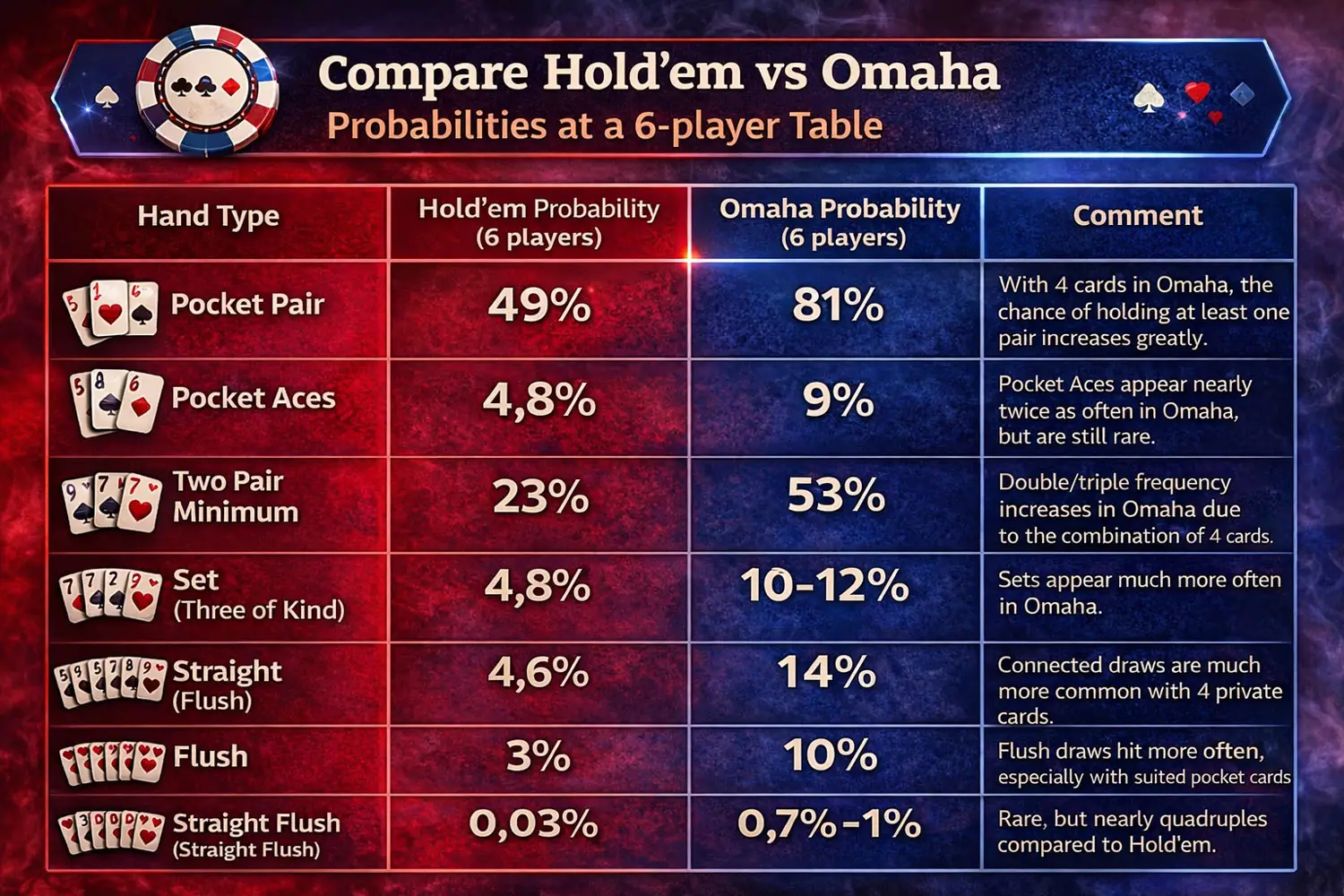
These structural differences directly affect the likelihood of making specific hands, which is critical to understanding why Omaha is often described as a game of big hands and big pots.
In Texas Hold’em, single pairs dominate showdown hands, while straights and flushes are relatively rare. In Omaha, the situation is reversed: the four private cards drastically increase the probability of connecting strongly with the board.
| Hand Type | Probability Hold’em (6 players) | Probability Omaha (6 players) | Comment |
|---|---|---|---|
| Pair in hand | 49% | 81% | Four hole cards in Omaha greatly increase the chance of holding at least one pair. |
| Pocket Aces | 4.8% | 9% | Pocket aces are almost twice as likely in Omaha, but remain rare. |
| Two Pairs Minimum | 23% | 53% | Frequency doubles or triples in Omaha due to combinatorics of four cards. |
| Three of a Kind (Trips) | 4.8% | 10–12% | Trips occur far more often in Omaha. |
| Straight | 4.6% | 14% | Connected draws are much more common with four hole cards. |
| Flush | 3% | 10% | Flush probability triples, especially with multiple suited cards. |
| Full House | 2.6% | 7–8% | Full houses are much more frequent in Omaha. |
| Four of a Kind | 0.17% | 0.7–1% | Quads are rare but appear more often than in Hold’em. |
| Straight Flush | 0.03% | 0.7–1% | Extremely rare, but roughly three times more likely in Omaha. |
It is common in Omaha for multiple players to simultaneously hold straights, flushes, or monster draws, significantly reducing the value of non-nut hands. Overall, preflop equities are much tighter in Omaha, as even premium hands like double-suited aces hold only a moderate advantage over well-connected holdings, unlike in Hold’em where some pocket pairs dominate.
Postflop Play: More Critical Than Ever
While Texas Hold’em sometimes allows players to win big pots through preflop pressure or well-timed continuation bets, Omaha requires a much more patient and structured approach after the flop. The prevalence of strong draws means that most of the hand’s value is decided on later streets.
Players must anticipate multiple future cards, evaluating not only their current holding but also how it will evolve against possible community cards. This complexity explains why Omaha is often considered more technical, despite its higher short-term variance.
Blocking effects are also far more important, as holding certain cards can dramatically change the probability that opponents hold the nuts or a strong redraw.
No-Limit poker vs Pot-Limit: Betting Dynamics Matter
Beyond the variant differences, betting structure plays a critical role in gameplay. Texas Hold’em is predominantly No-Limit, while Omaha is almost exclusively Pot-Limit, and this choice is intentional.
In No-Limit, the ability to shove an entire stack at any time creates maximum pressure, enabling polarized decisions and high-intensity bluffs. This freedom favors aggressive strategies and all-in confrontations preflop or on the flop.
Pot-Limit, on the other hand, caps the maximum bet size, reducing the ability to force immediate decisions. This limitation suits Omaha because the closely matched equities would otherwise make No-Limit excessively volatile and difficult to manage.
Why Pot-Limit is Essential in Omaha
If Omaha were played in No-Limit, swings would be extreme, as players could commit entire stacks with equities often only around 55–60%, making short-term variance overwhelming.
Pot-Limit allows pots to be built progressively, giving more room for decision-making across multiple streets, which rewards reading the board and opponents’ ranges. It also reduces catastrophic mistakes, as a bad call or raise rarely costs an entire stack in a single action.
Poker Bankroll Management and Variance
The differences between Omaha Pot-Limit and Texas Hold’em No-Limit have direct implications for bankroll management. Omaha exhibits higher short-term variance due to the frequency of multiway confrontations with strong equities.
However, over the long term, Pot-Limit mitigates some of this variance if players adopt disciplined strategies and avoid marginal spots without redraw potential. Hold’em No-Limit can appear more stable, but it exposes players to higher risk from poorly timed all-ins.
Strategic Adaptation: Two Games, Two Mindsets
Switching from Hold’em to Omaha requires a complete reevaluation of hand selection and strategy. Starting hands must be chosen with much more care, emphasizing connectivity, double suits, and potential to form nuts.
Aggression must also be calibrated, as overbetting in poker with medium-strength holdings can lead to costly reversals. In Omaha, controlling pot size with marginal hands and maximizing value with dominant hands is often the key to long-term success.
Conclusion: Two Variants, Two Philosophies
Texas Hold’em No-Limit and Omaha Pot-Limit poker share a common base, but their subtle differences shape two fundamentally distinct experiences. Card numbers, hand hierarchy, equity percentages, and betting structures transform every decision, demanding specialized skills.
Where Hold’em rewards pressure and simplicity, Omaha emphasizes technical discipline and constant forward-thinking. Mastering these distinctions is not optional; it is essential to avoid costly mistakes and maximize strategic advantage.
Personal note: Pot-limit Omaha is a fun and exciting game with many possibilities… I’ve enjoyed it more lately, as I tend to switch more between no-limit and pot-limit these last months, for I generally dislike pre-flop all-ins.
No responses yet