


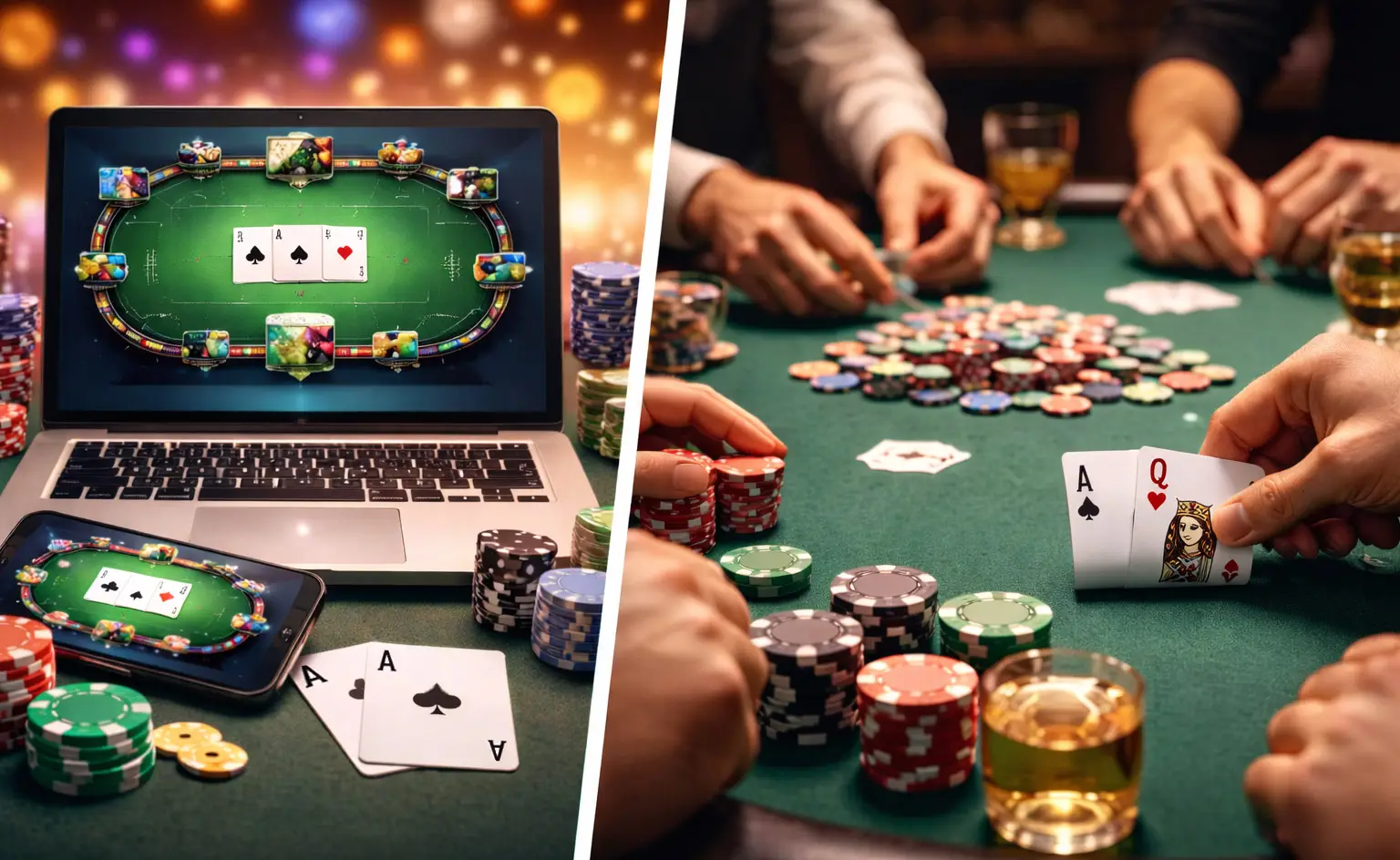
Online Poker vs Live Poker: Every Key Difference Explained
Poker has always been a game of skill, psychology, and adaptability. Over the past two decades, the rise of online poker has transformed how the game is played, studied, and experienced. While the core rules remain the same, online poker and live poker are fundamentally different environments, each requiring specific strategies, mental approaches, and skill sets.
As major tournaments, cash games, and professional players continue to move between both formats, understanding these differences has become essential. Even legendary players like Daniel Negreanu have openly discussed how online poker reshaped the modern game and forced live specialists to evolve.
This article explores all the major differences between online poker and live poker, from pace and psychology to strategy, variance, and profitability.
The Pace of Play: Speed vs Patience
One of the most obvious differences between online and live poker is speed.
Online poker is fast. Players can easily play 60 to 100 hands per hour per table, and many play multiple tables simultaneously. Decisions must be made quickly, often with time banks expiring in seconds. This pace rewards players who can process information rapidly, stay focused, and execute mathematically sound decisions without hesitation.
Live poker, on the other hand, is much slower. A typical live table deals 25 to 30 hands per hour, sometimes even fewer in large tournaments. This slower rhythm creates a very different atmosphere. Players have more time to observe opponents, think through hands, and engage in conversation.
According to Daniel, this slower pace is one reason live poker remains appealing: it allows for deeper psychological battles and creative hand reading that are harder to replicate online.
Physical Tells vs Digital Information
Live poker is famous for physical tells. Body language, breathing patterns, chip handling, posture, eye movement, and even speech can all reveal valuable information. Skilled live players learn to interpret these signals and disguise their own behavior.
Online poker eliminates physical tells entirely. Instead, players rely on bet sizing, timing tells, and statistical patterns. Actions like instant checks, delayed bets, or unusual sizing choices often replace traditional tells.
Negreanu has repeatedly stated that while live tells still exist, they are often overrated compared to betting patterns. Online poker forces players to focus on objective data, which has influenced how modern live poker is played. Today’s top professionals apply online-style logic even at live tables.
Poker Strategy Depth and Game Theory
Online poker tends to be more aggressive and mathematically precise. Because players face more hands and stronger competition, strategies are often closer to Game Theory Optimal (GTO) principles. Bluffing frequencies, balance, and range construction are critical.
Live poker is generally softer, especially at lower and mid stakes. Many players rely on intuition, experience, or habit rather than structured strategy. This creates more opportunities for exploitative play, where adapting to specific opponents can be highly profitable.
Negreanu has acknowledged that online poker forced him to modernize his approach, incorporating solver-based thinking and range analysis. He has also noted that many live players who ignore modern strategy risk falling behind.
Player Pool and Skill Levels
Online poker attracts a global player pool, meaning tougher competition overall. Even at lower stakes, players are often familiar with basic concepts such as position, continuation betting, and pot odds.
Live poker player pools are more localized. Casinos attract recreational players, tourists, and casual gamblers, especially in cash games. As a result, skill levels vary widely, and games can be significantly softer.
Negreanu has often said that live poker still offers incredible value, but only for players who understand how different the average live opponent is compared to an online grinder.
Variance and Volume
Because online poker allows players to play more hands, variance is higher in the short term but smoother in the long term. High volume reduces luck’s impact over time, making online poker more results-driven.
Live poker has lower volume, which means variance plays a larger role in short-term results. A few key hands can define an entire session or tournament.
Negreanu has explained that this is why many professionals combine both formats: online poker sharpens skills and generates volume, while live poker provides larger single-event payouts.
Multitabling vs Single-Table Focus
Online players often multitask. Playing four, six, or even more tables at once is common. This demands discipline, emotional control, and the ability to avoid autopilot mistakes.
Live poker forces players to focus on one table only. While this may seem easier, it requires sustained concentration for long periods, often under physically demanding conditions.
Negreanu has noted that fatigue affects live poker far more than online play, especially in long tournaments with extended days.
Emotional Control and Tilt
Online poker presents unique emotional challenges. Rapid losses, bad beats, and repeated coolers can happen within minutes. Without physical separation from the game, tilt can escalate quickly.
Live poker provides natural pauses between hands, which can help players regain composure. Social interaction and physical movement also reduce emotional overload.
However, Negreanu has pointed out that live tilt is often more expensive, as mistakes happen in larger pots with deeper stacks.
Table Dynamics and Social Interaction
Live poker is inherently social. Conversations, table talk, and personal dynamics influence the atmosphere. Players can manipulate perceptions, build images, and exploit social tendencies.
Online poker is more anonymous. Screen names replace faces, and chat features are often disabled or ignored. This reduces emotional reads but increases focus on technical execution.
Negreanu believes this difference is why some players thrive in one format but struggle in the other.
Poker Tools, Data, and Study Resources
Online poker allows players to track hands, review sessions, and analyze mistakes using software tools. This data-driven approach has raised the overall skill level dramatically.
Live poker players rely more on memory and experience. While note-taking is possible, it is less precise.
Negreanu has embraced technology in recent years, emphasizing that continuous study is now mandatory, regardless of format.
Profitability and Career Paths
Online poker offers consistency and flexibility. Players can play from anywhere and build steady income streams through volume.
Live poker offers higher variance but potentially larger rewards, especially in major tournaments.
Negreanu has stated that the most successful modern professionals are those who adapt to both worlds, using online poker to refine strategy and live poker to maximize earnings.
The Future of Poker: A Hybrid Game
The gap between online and live poker is narrowing. Online concepts now dominate live strategy, while live experience improves emotional intelligence online.
Negreanu believes the future belongs to complete players—those who understand mathematics, psychology, and adaptability across both formats.
Poker is no longer about choosing one side. It’s about mastering the differences and using them to your advantage.
Conclusion
Online poker and live poker are the same game played in radically different ways. Speed, strategy, psychology, variance, and competition all shift depending on the format. Learning these differences is essential for long-term success.
As Daniel’s career illustrates, adaptability is the true edge. Whether online or live, poker rewards those willing to evolve.

No responses yet