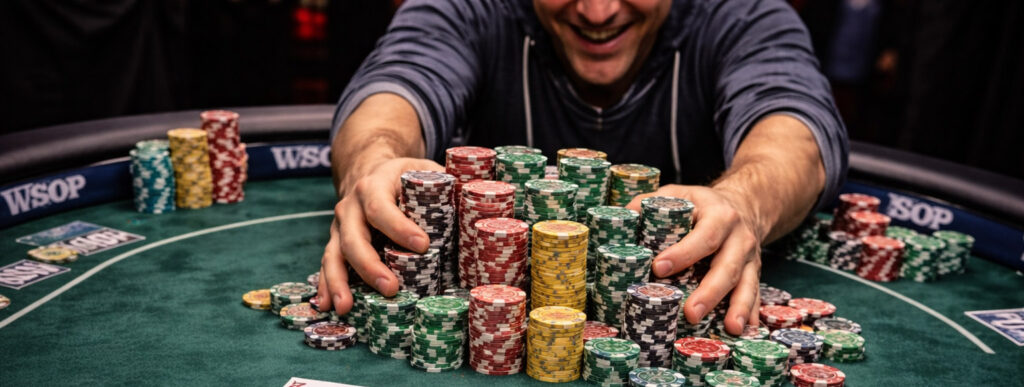
Poker is often described as a battle of probabilities, mathematics and mental discipline. Yet at the very heart of the game lies one of its most powerful and fascinating weapons: the bluff. Capable of turning a weak hand into a spectacular victory, bluffing represents the true essence of modern poker. It is not simply about deception, but about telling a believable, consistent story that places psychological pressure on opponents.
Over the decades, the world’s biggest poker tournaments, especially the World Series of Poker (WSOP) in Las Vegas, have delivered legendary moments thanks to perfectly executed bluffs. These bold plays have sometimes changed the course of a tournament, and in some cases, an entire career.
Why Bluffing Is Essential in Poker
Without bluffing, poker would become a static and predictable card game. The ability to bet without holding the best hand forces every player to remain alert at all times.
Bluffing introduces uncertainty, tension and psychological warfare that go far beyond card strength.
A player who never bluffs quickly becomes readable. Conversely, a player who bluffs at the right moments forces opponents into costly mistakes. Bluffing also protects strong hands: when opponents know you can bet both with and without value, every decision they face becomes significantly harder.
The Different Types of Bluff
The Pure Bluff
This involves betting or raising with a very weak hand and little to no chance of improvement. It relies almost entirely on opponent reads and the credibility of the betting line.
The Semi-Bluff
Widely used in modern poker, the semi-bluff combines a currently weak hand with strong drawing potential. This approach offers two ways to win the pot: forcing a fold immediately or improving on later streets.
The Pressure Bluff
Common in tournament play, this bluff uses stack sizes and payout implications to push opponents off marginal hands. The later stages of the WSOP provide the perfect environment for this type of play.
Bluffing as a Tournament Strategy
In tournaments, and especially at the WSOP, bluffing becomes even more critical. Prize structures, chip value and payout pressure make every decision more consequential.
A successful bluff can:
- win pots without showdown,
- preserve a healthy stack,
- establish psychological dominance at the table,
- build an aggressive, intimidating table image.
However, poorly timed bluffs can quickly lead to elimination. That is why elite players use bluffing selectively, with precision and purpose.
Five of the Greatest Bluffs in WSOP History (1980–2025)
Ranked from most recent to oldest
1. Espen Jørstad >> WSOP Main Event 2022
During the 2022 Main Event, Espen Jørstad delivered a massive bluff late in the tournament. Against a strong opponent, he applied consistent pressure across multiple streets before firing a large river bet, representing an extremely strong hand. His opponent eventually folded.
This bluff perfectly illustrates timing mastery and tournament awareness, two pillars of modern poker strategy.
2. Joe McKeehen >> WSOP Main Event 2015
On his path to victory in 2015, Joe McKeehen stood out for relentless aggression. One of his most memorable bluffs came at a pivotal stage, where he used his deep stack to force an opponent off a reasonable holding. This play strengthened his dominant table image and contributed directly to his championship run.
3. Darvin Moon >> WSOP Main Event 2009
Facing Phil Ivey, one of the most feared players in poker history, Darvin Moon executed a memorable bluff. On the river, he made a convincing bet on a dangerous board, representing a very strong hand. Even Ivey chose to fold. The moment became one of the most talked-about hands of the tournament.
4. Greg Merson >> WSOP Main Event 2012
World Champion in 2012, Greg Merson demonstrated exceptional understanding of tournament dynamics. One of his key bluffs came against a cautious opponent, whom he pushed off a medium-strength hand through a consistent and aggressive betting line. This hand perfectly symbolised the balance between patience and boldness.
5. Chris Moneymaker >> WSOP Main Event 2003
No discussion of bluffing is complete without the hand that changed poker history. In 2003, Chris Moneymaker pulled off a legendary bluff against Sam Farha. On the river, he bet with the inferior hand, representing a flush he did not have. Farha folded, and the hand became the symbol of the global poker boom and the birth of the modern poker era.
The Skills Required to Execute a Successful Bluff
A great bluff is never random. It requires:
- accurate reads on opponents,
- a deep understanding of board texture,
- precise bet sizing,
- consistency in storytelling throughout the hand.
The best bluffs are those that make complete sense from start to finish. One inconsistency can be enough to get called.
Bluffing in the Modern Poker Era
With video analysis, advanced statistics and solvers, bluffing has evolved. Today, it is embedded within balanced strategies where every bet is calculated to remain unpredictable. Modern WSOP tournaments feature fewer flashy bluffs, but more frequent and mathematically justified ones.
Yet despite technological advances, the human factor remains decisive. Fear, ego and pressure continue to shape decisions, ensuring that well-timed bluffs will always have a place at the table.
Conclusion
Bluffing is far more than a simple deception at the poker table. It is a strategic weapon, a psychological lever and a refined art that separates good players from legends. From the WSOP of the 1980s to recent editions, many of the greatest poker moments were born from bold, perfectly executed bluffs.
Mastering bluffing means understanding poker as a whole: a game where logic, courage and psychology combine to create unforgettable moments.